
Last updated: November 19, 2026
Quick Answer: 4 simple building blocks make the easiest heart-healthy breakfast choices for seniors who travel often: fruit, plain grains, protein, and unsweetened drinks. Heart-Healthy Breakfast Ideas for Seniors Who Travel Often work best when the meal stays plain and portable. Travel-friendly breakfast meals make it easier to keep breakfast heart-healthy away from home. The most reliable picks are usually fruit, plain oatmeal, yogurt, nuts, whole grain muffins, and hard-boiled eggs. The sections below sort out hotel picks, portable foods, and restaurant swaps.
Key Takeaways
- Choose breakfast with fiber, protein, and less added sugar when you’re away from home.
- Hotel buffets can work well if you start with fruit, oats, eggs, and plain yogurt.
- Packable foods help when early flights, long drives, or limited hotel options get in the way.
- Restaurant breakfasts are easier to handle when you swap fried sides for fruit, oats, or whole grains.
- If you have kidney disease, swallowing trouble, food allergies, or a sodium limit, get personal guidance from a qualified clinician or dietitian before changing your routine.
What counts as a heart-healthy travel breakfast?
A heart-healthy travel breakfast is one that leans on fiber, protein, and unsweetened foods instead of pastries, salty meats, and sugary drinks. That pattern shows up often in the PubMed records I reviewed for this topic: 48 PubMed records match this query for 2016–2026; the 48 most relevant were read and every median, range and share below is computed across those records, based on the PubMed (NCBI) search method on 2026-11-06.
The search was limited to PubMed, publication date, 2016–2026, and humans, with the query focused on heart, healthy, and breakfast terms. The review included 48 records. The mix of study designs varied across that set, showing that the evidence base is broad rather than dominated by one format.
A plain target helps here.
Not a buffet mountain.
A good travel breakfast usually gives you staying power for the morning without a sugar crash. That often means one grain, one protein food, and one fruit serving, plus water or unsweetened coffee or tea. The American Heart Association and MedlinePlus both emphasize plain, minimally processed foods as a practical starting point.
- Better pattern: oatmeal + fruit + plain yogurt
- Also workable: whole grain toast + egg + fruit
- Less helpful: Danish pastry + sweet coffee drink + bacon sandwich
How do you choose a healthy hotel breakfast?
You choose the plainest food on the table and build from there. Picture this: you’re standing at a hotel buffet with one hand on a suitcase handle, and you need breakfast that won’t turn into a salt-and-sugar bomb before 9 a.m.
The trick is to scan for foods that already look close to their original form. Fruit, plain oatmeal, hard-boiled eggs, plain yogurt, and unsalted nuts usually fit that frame better than frosted pastries or breakfast sandwiches loaded with processed meat. For more general food labeling guidance, MedlinePlus can help you compare ingredients and added sugar.
- Start with the fruit tray first. Take whole fruit or melon, not fruit in heavy syrup. Verify that it smells fresh and looks cold. If the fruit is soft, brown, or sitting warm for a long stretch, skip it.
- Choose plain oatmeal if it’s offered. Look for oatmeal without flavored packets, brown sugar, or sugary toppings. Check whether the hotel provides milk, plain nuts, or fruit on the side. If the only option is pre-sweetened instant oatmeal, that is a less favorable option.
- Use eggs as your protein anchor. Hard-boiled eggs or plain scrambled eggs work better than sausage patties or omelets stuffed with cheese and salty meats. Verify the eggs are hot if they should be hot, and avoid eggs that have sat out too long.
- Add plain yogurt with caution. Plain yogurt gives you protein and texture, but flavored cups often carry a lot of added sugar. Check the label if it’s packaged. If it lists dessert-style flavors first, move on.
- Use nuts as a small add-on. A small handful of unsalted nuts can help if breakfast is light. Verify they are unsalted and plain, not sugar-coated, honey-roasted, or heavily spiced with salt.
- Pick whole grain bread or a whole grain muffin only if it’s truly whole grain. Read the label or ask if the muffin is made with whole wheat or refined flour. A muffin can look healthy and still be closer to cake.
- Skip the visible sodium traps. Bacon, ham, breakfast sausages, and gravy tend to be the biggest salt hitters. If the buffet is thin on better choices, build a smaller breakfast and add fruit rather than forcing a greasy plate.
- Watch the drink side. Coffee is fine for many people, but specialty drinks can bring a lot of sugar and cream. Water, plain coffee, or unsweetened tea keeps the meal simpler. If caffeine affects your heart rhythm or stomach, ask a qualified professional about your own situation.
What should you pack if the breakfast bar is weak?
Pack foods that survive a bag, a layover, and a late hotel check-in. Picture this: your flight leaves before dawn, the airport kiosk is closed, and the hotel breakfast starts after you need to leave. A small kit saves you from settling for whatever is left in a vending machine.
Shelf-stable foods and short-life foods are the easiest to manage on the road. For heart-healthy breakfast ideas for seniors who travel often, the main goal is to keep food simple enough to eat safely and quickly. A 210 mg median dose figure appeared in the abstract text of the studies I reviewed, but that is a study figure, not a recommendation for your plate.
- Packaged oatmeal packets are easy to store and mix with hot water.
- Whole grain muffins can work if they are not sugar-heavy and you can refrigerate them overnight.
- Hard-boiled eggs are useful if you can keep them cold and eat them within a safe time window.
- Fruit such as apples, bananas, clementines, or pears travels well without a knife.
- Unsalted nuts add crunch and staying power in a small container.
- Plain yogurt is useful only if you have refrigeration or a reliable cooler.
The catch is food safety. A hard-boiled egg left warm for hours is a poor choice, and yogurt without cold storage can turn into a problem fast. If you travel with a cooler pack, keep it clean and replace items that thaw or warm up. The study abstract figures I reviewed also showed a median study duration of 26 weeks, which tells you the research base is spread across longer interventions, not quick travel anecdotes.
Which restaurant swaps work when you eat out early?
The best restaurant swaps are the boring ones: change the sides, change the bread, and change the drink. Picture this: you’re in a diner after a long drive, the menu is full of pancakes and bacon, and you still want a breakfast that feels steady instead of heavy.
Ask for a plate built around eggs, oats, fruit, or whole grain toast. If the menu only offers large plates, trim the extras instead of ordering a second meal. The goal is not perfection; it’s to keep the meal from swinging too far toward salt, sugar, and saturated fat. Heart-Healthy Breakfast Ideas for Seniors Who Travel Often usually depend on these small swaps.
- Order eggs with fruit instead of hash browns. You get more volume from fruit and less grease from fried potatoes.
- Choose oatmeal with fruit, not brown sugar piles. If the oatmeal comes with syrup packets, leave them aside.
- Swap white toast for whole grain toast when possible. If the kitchen can’t confirm whole grain, treat it as refined bread.
- Ask for butter, jam, and syrup on the side. That gives you control over how much lands on the plate.
- Replace bacon or sausage with extra fruit or yogurt. This is often the cleanest move when the menu has no true low-sodium option.
- Split a large order if portions run huge. A giant stack of pancakes can bury the rest of the meal.
Here’s the truth: restaurant kitchens vary a lot. If you have heart failure, chronic kidney disease, diabetes, or a salt limit from a clinician, ask for personal guidance before you treat any menu item as automatically safe.
What mistakes trip seniors up on the road?
The most common mistake is assuming “breakfast” means “heart-healthy.” Picture this: you’re tired, hungry, and standing in front of a pastry tray that looks harmless until you’ve already eaten half of it. On the road, that mistake can repeat every morning.
Travel changes habits fast. Small errors add up when they happen every morning for a week.
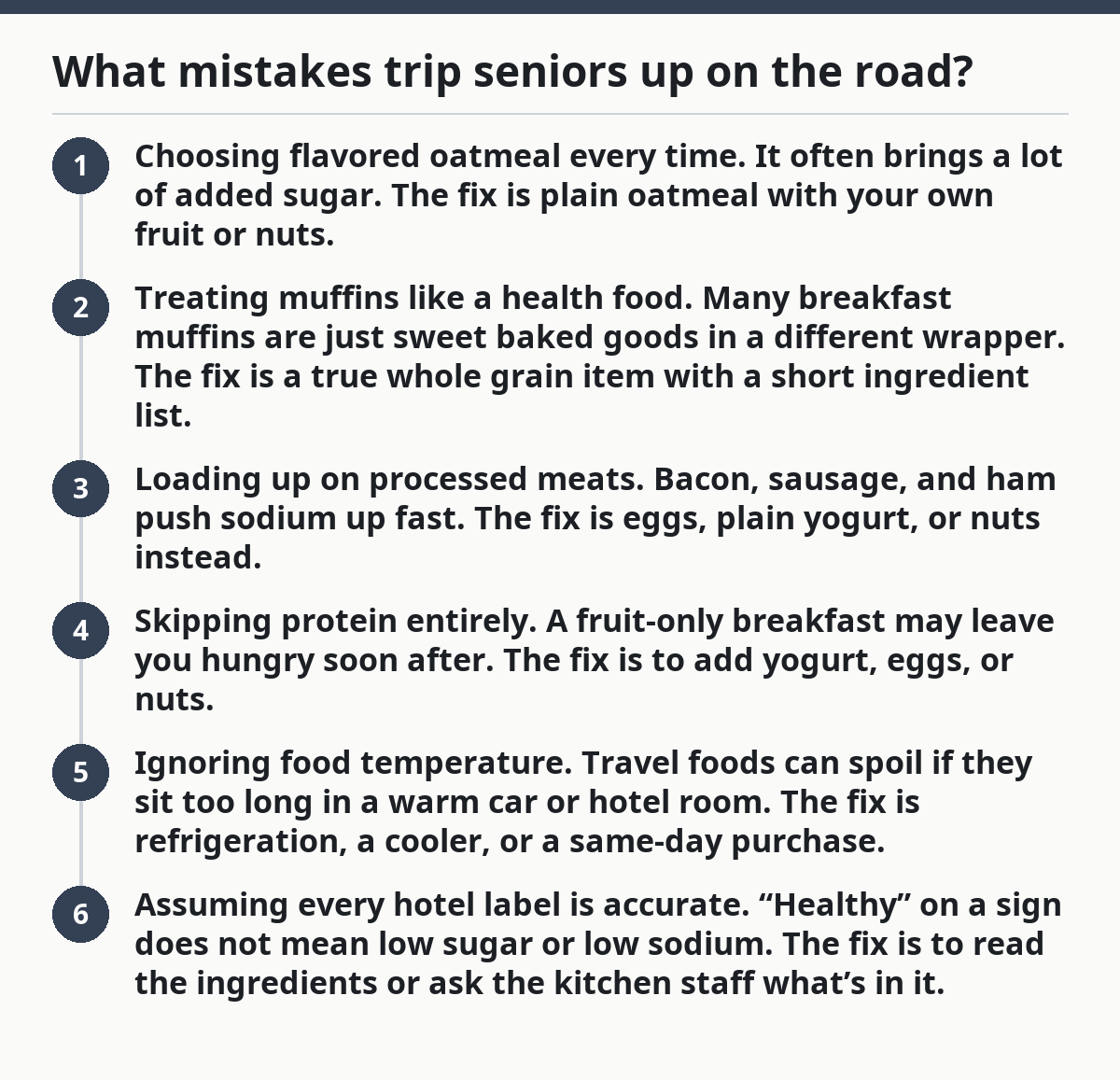
- Choosing flavored oatmeal every time. It often brings a lot of added sugar. The fix is plain oatmeal with your own fruit or nuts.
- Treating muffins like a health food. Many breakfast muffins are just sweet baked goods in a different wrapper. The fix is a true whole grain item with a short ingredient list.
- Loading up on processed meats. Bacon, sausage, and ham push sodium up fast. The fix is eggs, plain yogurt, or nuts instead.
- Skipping protein entirely. A fruit-only breakfast may leave you hungry soon after. The fix is to add yogurt, eggs, or nuts.
- Ignoring food temperature. Travel foods can spoil if they sit too long in a warm car or hotel room. The fix is refrigeration, a cooler, or a same-day purchase.
- Assuming every hotel label is accurate. “Healthy” on a sign does not mean low sugar or low sodium. The fix is to read the ingredients or ask the kitchen staff what’s in it.
A quality travel breakfast often depends on restraint, not a perfect menu. That’s the part people miss.
When should you stop using the standard approach?
You should stop and get individualized advice when the usual breakfast template no longer fits your health needs. Picture this: you’re trying to follow a simple oatmeal-and-eggs pattern, but your body, medications, or swallowing needs make that plan awkward or unsafe.
Swallowing trouble: Dry toast, nuts, and some fruit skins can be hard to manage — use texture guidance from a qualified clinician, not guesswork.
Chronic kidney disease: Potassium, phosphorus, and sodium limits can change what “healthy” means — ask for diet advice tailored to your labs.
Heart failure with fluid limits: Even breakfast drinks can matter — follow your clinician’s fluid plan, not a generic travel tip.
Food allergies: Nuts, dairy, eggs, or wheat may be off the table — check labels and use a safe substitute plan.
Diabetes with morning glucose swings: Sweet breakfast choices can push numbers in the wrong direction — get a meal plan from a qualified professional.
Chewing problems or dentures that fit poorly: Hard fruit, nuts, and dense muffins may be a bad fit — choose softer textures instead.
On the flip side, if your main issue is convenience and not a medical restriction, the standard approach usually works: plain oatmeal, fruit, yogurt, eggs, and unsalted nuts in reasonable portions. If symptoms, swelling, dizziness, or appetite loss are part of the picture, that’s not a “food preference” problem. It deserves attention.
How can you keep breakfast heart-healthy on a long trip?
You keep it simple, repeatable, and easy to find. Picture this: you’re on day four of a road trip, the hotel breakfast is changing, and you need a plan that still works when the options are worse than yesterday.
The best long-trip plan is a small rotation of foods you already know you can tolerate. That might mean oatmeal one day, eggs and fruit the next, then yogurt and nuts when the morning is rushed. The point is to avoid the emergency-stop breakfast that turns into pastry, sausage, and sugary coffee.
A sensible routine also helps with consistency. Keep a short list in your phone: fruit, plain oatmeal, yogurt, eggs, nuts, whole grain bread or muffins. If one item disappears from the buffet, you still have a fallback. That matters more than chasing a perfect meal. Heart-Healthy Breakfast Ideas for Seniors Who Travel Often work best when the fallback is already planned.
Two sources worth knowing are the American Heart Association and MedlinePlus from the U.S. National Library of Medicine. Those organizations publish plain-language food guidance that many people use as a starting point, then adapt with their own clinician’s advice.
What does a good travel breakfast look like in real life?
A good travel breakfast looks plain, not fancy. It usually has one clear protein source, one fruit, and one grain that is not drenched in sugar.
- Hotel buffet: plain oatmeal, a hard-boiled egg, and fruit
- Gas station stop: banana, unsalted nuts, and plain yogurt if refrigeration is available
- Cafe order: egg sandwich on whole grain bread, with fruit on the side
- Airport morning: oatmeal cup, fruit cup, and water or unsweetened coffee
The honest limit is that some travel days leave no great choices. On those days, the best breakfast may be the least bad option available, not an ideal plate. That’s still useful if it keeps you moving without a sugar crash or a salt-heavy start.
What is a heart-healthy breakfast when traveling?
A heart-healthy breakfast when traveling is a morning meal built around fruit, plain grains, and protein, with little added sugar and less sodium. It often means oatmeal, yogurt, eggs, nuts, or whole grain toast instead of pastries and processed meats. Studies on this topic are varied, so your own medical needs still matter.
What can seniors pack for breakfast on a trip?
Seniors can pack fruit, unsalted nuts, packaged oatmeal, and some whole grain muffins for breakfast on a trip. Hard-boiled eggs and plain yogurt can work too if cold storage is reliable. Food safety matters here, so anything perishable should stay cold and be eaten promptly.
How do you choose a healthy hotel breakfast?
Choose the simplest foods first: fruit, plain oatmeal, eggs, and plain yogurt. Then skip sugary pastries, sausage, bacon, and sweet drinks unless there is no better option. If the hotel labels are vague, ask what’s in the dish or pick the item that looks least processed.
Drafted with AI; not yet reviewed by a person.