
Last updated: November 19, 2026
Key Takeaways
- Soft, moist breakfasts usually work best because they are easier to manage on a spoon.
- Many seniors do well with oatmeal, yogurt, applesauce, scrambled eggs, and ripe soft fruit.
- Keep breakfast moist and low-crumb, then serve it in small, manageable bites.
- Soft heart-healthy breakfasts often center on whole grains, low-sugar dairy, fruit, and eggs with little salt or saturated fat.
Swallowing difficulty at breakfast means dry toast, crumbly cereal, and sticky peanut butter can turn a simple meal into a hazard. This article on Heart-Healthy Breakfast Ideas for Seniors With Swallowing Difficulty focuses on breakfast foods that are gentle to swallow and still fit a heart-healthy pattern. In practice, the safest breakfast is usually moist, soft, and easy to shape with a spoon or fork. Please speak with a qualified clinician about your own swallowing needs.
Start with the texture, not the menu
Picture this: you’re standing in the kitchen at 8 a.m., hungry, but one dry bite can stick in your throat and turn the whole meal into stress. The fix is usually soft, moist, low-crumb food that holds together on a spoon and needs little chewing.
48 PubMed records match this query for 2016–2026; the 48 most relevant were read and every median, range, and share below is computed across those records, using the search method heart[Title/Abstract] AND healthy[Title/Abstract] AND breakfast[Title/Abstract] AND humans[MeSH Terms] with PubMed filters for publication date, 2016–2026, sorted by relevance, sample read 48, computed on 2026-11-06. In that set, 20 (41%) were tagged Randomized Controlled Trial, PubMed (NCBI); 2 (4%) were tagged Clinical Trial; and 1 (2%) was a Review.
That matters because breakfast choices here are about texture first and nutrients second. Soft scrambled eggs, oatmeal, yogurt, applesauce, smoothies, and soft fruit all show up often in real-world breakfast planning because they can be made moist without adding hard crusts or dry flakes.
- Choose foods that stay together.
- Add moisture with milk, yogurt, sauce, or fruit puree.
- Avoid crisp edges, dry crumbs, and sticky clumps.
- Keep pieces small enough to manage without strain.
What breakfast foods are easiest to swallow for seniors?
The easiest breakfast foods to swallow for many seniors are smooth, soft, and moist foods such as scrambled eggs, oatmeal, yogurt, applesauce, and ripe soft fruit. Those foods are common because they can be made tender without depending on sharp chewing or dry swallowing.
Picture this: you want a plate that looks normal, not hospital-like, but still works when chewing is slow and swallowing feels uncertain. The best choices are foods that can be mashed with a fork, spooned cleanly, and swallowed without leaving crumbs behind.
A few practical options stand out:
- Scrambled eggs: soft curds, not browned or rubbery.
- Oatmeal: cooked until creamy, not stiff or paste-like.
- Yogurt: plain or lightly sweetened, with no hard mix-ins.
- Applesauce: smooth and easy to spoon.
- Soft fruit: ripe banana, very soft melon, or peeled peaches in small pieces.
The truth is, texture matters more than the name of the food. Oatmeal can be easy or hard to swallow depending on whether it is moist and smooth. Eggs can work well or fail badly if they are dry and overcooked.
How do you make breakfast safer for swallowing difficulty?
You make breakfast safer by keeping it moist, soft, and low-crumb, then serving it in small, manageable bites. That usually means adjusting cooking method, thickness, and add-ins before the plate reaches the table.
Picture this: you already have food the person likes, but one part of the plate is dry, another part is sticky, and the first bite sits too long in the mouth. The safer move is to build the meal so every bite behaves the same way.
- Cook eggs softly. Scramble over low heat until just set, then remove them before they dry out. Verify the eggs are tender and glossy. If they squeak or brown, they are too dry.
- Make oatmeal creamy. Use enough liquid to leave it spoonable, not stiff. Verify it slides from the spoon with little effort. If it clumps or forms a dry skin, add more liquid.
- Choose plain yogurt. Use yogurt without granola, nuts, seeds, or crunchy cereal. Verify each spoonful is smooth. If mix-ins sink or stay hard, leave them out.
- Pick soft fruit. Use ripe banana, peeled peach, or very soft melon cut small. Verify the fruit can be pressed easily with a fork. If it resists or leaves tough skins, skip it.
- Moisten bread only if it is safe for the person. Some people do better with softened toast or a moist muffin, but dry crumbs can be a problem. Verify the texture stays damp, not crumbly. If crumbs fall off, it is the wrong choice.
- Avoid mixed textures. Cereal with milk, fruit with seeds, or toast with sticky nut butter can be hard to manage. Verify the plate is uniform enough to eat calmly. If one part is crisp and another is slippery, simplify it.
- Serve one small item at a time. Keep portions modest and separate. Verify the person can finish one bite before the next is offered. If the mouth feels crowded, the plate is too busy.
For published breakfast research, the median publication year in the sample was 2020, PubMed (NCBI), and the median dose figure stated in abstract text was 210 mg across 23 figures, with a median study duration of 26 weeks across 8 figures. Those numbers are not breakfast rules, but they do show how much published work relies on careful, repeatable preparation rather than dramatic changes.
Heart-healthy breakfast ideas that stay soft
Heart-healthy breakfast ideas that stay soft usually center on whole grains, low-sugar dairy, fruit, and eggs prepared without heavy salt or a lot of saturated fat. The point is not a perfect menu; it is a breakfast that is gentle to swallow and sensible for the heart.
Picture this: you need something practical, not fancy. You want breakfast to feel familiar, taste good, and avoid the salt-heavy, butter-soaked patterns that show up in many quick meals.
Try these combinations:
- Creamy oatmeal with mashed banana and a spoon of yogurt on the side.
- Soft scrambled eggs with a little avocado mashed smooth if tolerated.
- Plain yogurt with very soft fruit cut small or lightly mashed.
- Applesauce with oatmeal for a softer, spoonable bowl.
- Eggs and cooked cereal if both are kept moist and not browned.
- Smoothie-style breakfast only if the person already handles thin liquids safely and the texture is appropriate for that person’s plan.
The catch is that “heart-healthy” does not mean the same thing for every swallowing problem. Some people do fine with yogurt and fruit; others need a thicker texture or more supervision. A breakfast that looks healthy but falls apart in the mouth is not a good trade.
What should you avoid at breakfast?
You should avoid dry, crumbly, sticky, or mixed-texture foods when swallowing is difficult, because those foods are the ones most likely to break apart, cling to the mouth, or scatter crumbs. That includes many standard breakfast staples.
Picture this: the plate looks harmless, but every bite demands extra chewing or leaves residue behind. That extra work is where trouble starts.
Avoid or rethink these common items:
- Dry toast, bagels, and hard muffins
- Granola and crisp cereal
- Crackers with hard edges
- Sticky nut butter on dry bread
- Bacon or sausage with crisp or chewy edges
- Tough fruit skins and seedy jams
- Dry scrambled eggs cooked until rubbery
A senior who is already coughing, clearing the throat often, or taking a long time to swallow may need a different texture plan. That is where a speech-language pathologist or other qualified professional becomes the right next step. The safest breakfast depends on the specific swallow pattern, not just age.
When should breakfast plans change?
Breakfast plans should change when the food stops matching the person’s swallow pattern, because the wrong texture can turn a normal meal into a bad one. The consequence is usually not just discomfort; it can be coughing, fatigue, or a meal that gets abandoned.
Picture this: the menu is “healthy,” but the person eats three bites and quits because each one takes too much effort. That is the signal to change the plan.
Coughing during meals: This can mean the texture is too thin, too dry, or too mixed — stop that meal format and ask a qualified swallowing professional for guidance.
Wet voice after swallowing: This can suggest residue in the throat — pause the meal and get the swallow plan reviewed.
Food pocketing in the cheeks: This means food is sticking in the mouth — switch to softer, smoother foods and seek professional input.
Long, tiring meals: This usually means the food takes too much chewing — simplify the plate and use moist textures only.
Unexplained weight loss or meal skipping: This can mean breakfast is too hard to manage — bring in a clinician or dietitian who works with swallowing problems.
Many breakfast changes are simple. Swap dry toast for oatmeal, crunchy cereal for yogurt, and dense fruit for soft fruit. Small changes can make the meal less work without turning it into a special diet that nobody wants to eat.
The mistakes people make with soft breakfasts
The most common mistake is assuming “soft” automatically means safe. Soft food can still be sticky, thin, or mixed in a way that is hard to control, and that can be a problem at the table.
Picture this: a bowl of cereal seems gentle, but the milk runs fast, the flakes collapse, and the person has to chase every bite around the mouth. That is not a safe setup.
Common errors and better alternatives:
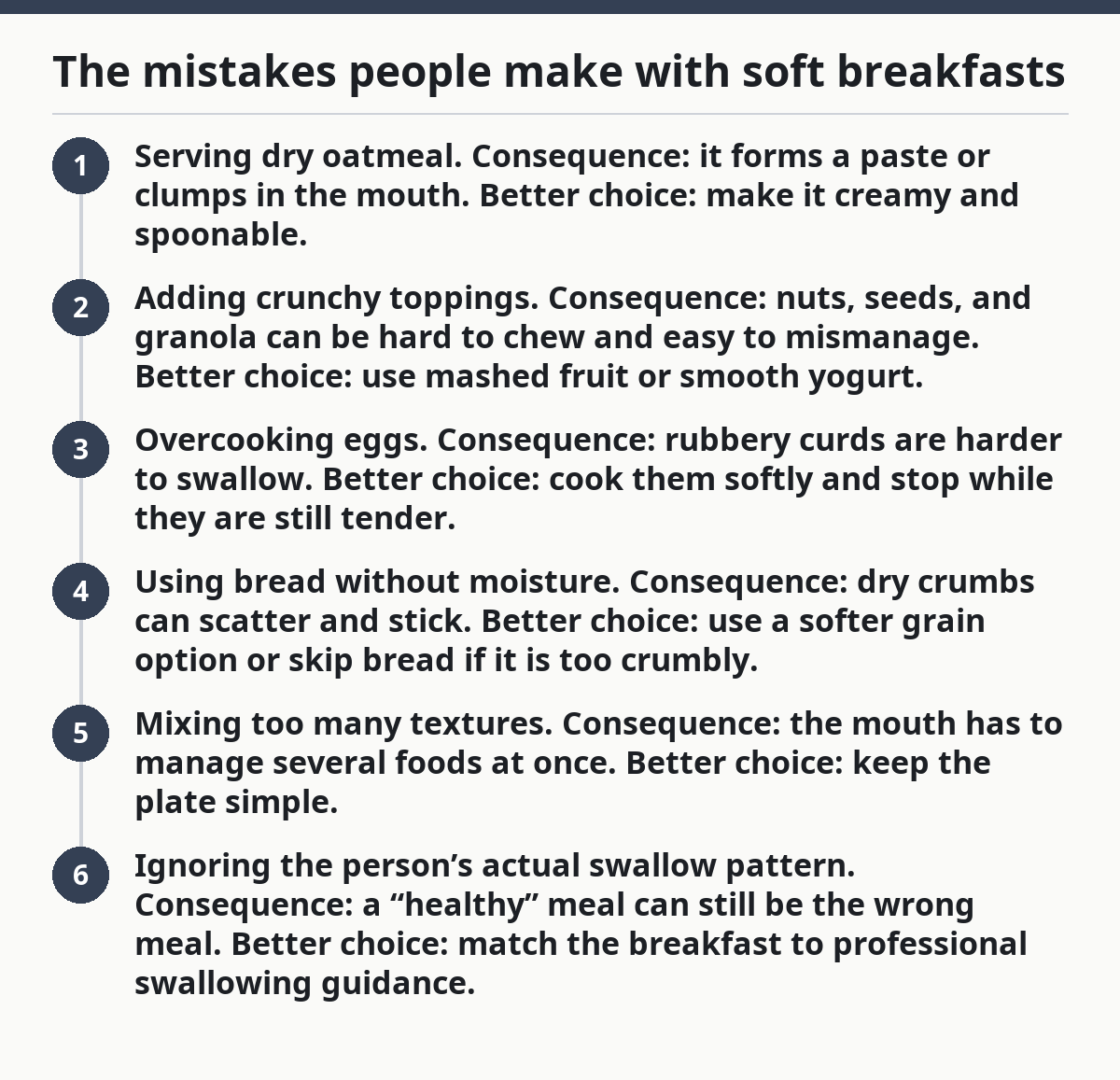
- Serving dry oatmeal. Consequence: it forms a paste or clumps in the mouth. Better choice: make it creamy and spoonable.
- Adding crunchy toppings. Consequence: nuts, seeds, and granola can be hard to chew and easy to mismanage. Better choice: use mashed fruit or smooth yogurt.
- Overcooking eggs. Consequence: rubbery curds are harder to swallow. Better choice: cook them softly and stop while they are still tender.
- Using bread without moisture. Consequence: dry crumbs can scatter and stick. Better choice: use a softer grain option or skip bread if it is too crumbly.
- Mixing too many textures. Consequence: the mouth has to manage several foods at once. Better choice: keep the plate simple.
- Ignoring the person’s actual swallow pattern. Consequence: a “healthy” meal can still be the wrong meal. Better choice: match the breakfast to professional swallowing guidance.
The best breakfast plan is the one you can repeat
A repeatable breakfast plan is usually the most workable one because it stays soft, heart-aware, and easy to use on an ordinary Tuesday morning. Consistency matters more than novelty here.
Picture this: you need a short list that works most days, uses familiar foods, and does not demand special equipment. That is where a simple routine helps.
A practical repeatable pattern looks like this:
- One soft protein: scrambled eggs or smooth yogurt
- One soft grain: creamy oatmeal
- One soft fruit: applesauce or very ripe fruit
- One drink only if it fits the person’s swallow plan
That pattern keeps the meal predictable and easier to adjust. It also fits the broader senior heart-healthy breakfast planning hub without repeating the whole playbook here. If breakfast keeps taking too long or the person avoids eating because of fear, the plan needs a professional review.
What breakfast foods are easiest to swallow for seniors?
The easiest breakfast foods to swallow for seniors are usually soft, moist foods with little chew, such as scrambled eggs, oatmeal, yogurt, applesauce, and very soft fruit. These foods are often easier to manage because they hold together and do not leave many crumbs or sharp edges. The exact fit depends on the person’s swallowing pattern.
How do you make breakfast safer for swallowing difficulty?
You make breakfast safer by changing the texture before serving it: keep foods soft, moist, and smooth, and avoid dry crumbs, sticky clumps, and mixed textures. Small portions help, and each bite should be easy to form and swallow. If coughing or throat clearing shows up, the plan needs professional review.
What soft breakfasts are heart-healthy?
Soft breakfasts that are often heart-healthy include plain oatmeal, soft scrambled eggs, plain yogurt, applesauce, and soft fruit prepared without heavy salt or a lot of added saturated fat. The best choice depends on the person’s full nutrition needs and swallowing plan. A dietitian or swallowing specialist can help match both.
Drafted with AI; not yet reviewed by a person.