
Last updated: November 19, 2026
Quick answer: build each lunch around 4 parts — a low-sodium protein, a high-fiber base, a vegetable, and a fruit — and pack them in the same order every time so the meal stays heart-friendly and easy to assemble. In this guide to Heart-Healthy Senior Lunch Ingredient Building and Packing Systems, the goal is a system that is simple, repeatable, and gentle on older adults who may be managing blood pressure, appetite changes, chewing trouble, or lower energy.
Key takeaways
- A heart-healthy senior lunch works best when the same few ingredients repeat across the week.
- The packing order matters as much as the ingredients, because it keeps textures from turning soggy and makes the meal easier to finish.
- Sodium is the main trap in packaged lunches, canned soups, deli meat, sauces, and flavored grains.
- A good system uses 1 protein, 1 grain or starchy base, 2 vegetables or fruit portions, and a fat that adds flavor without piling on salt.
- The wrong system is the one that depends on willpower every day. The right one uses containers, labels, and a short shopping list.
What makes a senior lunch heart-healthy?
A heart-healthy senior lunch is built to keep sodium, saturated fat, and added sugar lower while still giving enough protein, fiber, and fluid-rich foods. For many older adults, that means a meal that is filling but not heavy, soft enough to chew if needed, and easy to reheat or eat cold.
According to the American Heart Association, many adults are advised to keep sodium below 2,300 mg per day, and the organization notes that 1,500 mg is an ideal limit for many people. That matters at lunch because a single sandwich, soup, or frozen meal can take up much of that room before dinner even starts. The U.S. Dietary Guidelines for Americans also advise choosing foods that fit a healthy dietary pattern instead of building each meal from scratch with guesswork. A useful starting point is the USDA MyPlate model, which divides the plate into vegetables, fruits, grains, and protein. For a quick reference on these patterns, see the AHA sodium guidance and the USDA MyPlate page.
For an older adult, heart health is not only about salt. It is also about food that gets eaten. A lunch that looks “perfect” on paper but is hard to chew, too dry, too big, or too bland may come back half-finished. That is why ingredient building matters. Soft cooked vegetables, canned beans rinsed under water, plain yogurt sauces, and tender proteins often work better than dry, highly seasoned items. If blood pressure, kidney disease, diabetes, or chewing problems are part of the picture, a clinician or dietitian can help narrow the plan safely.
Which ingredients should be the core of the system?
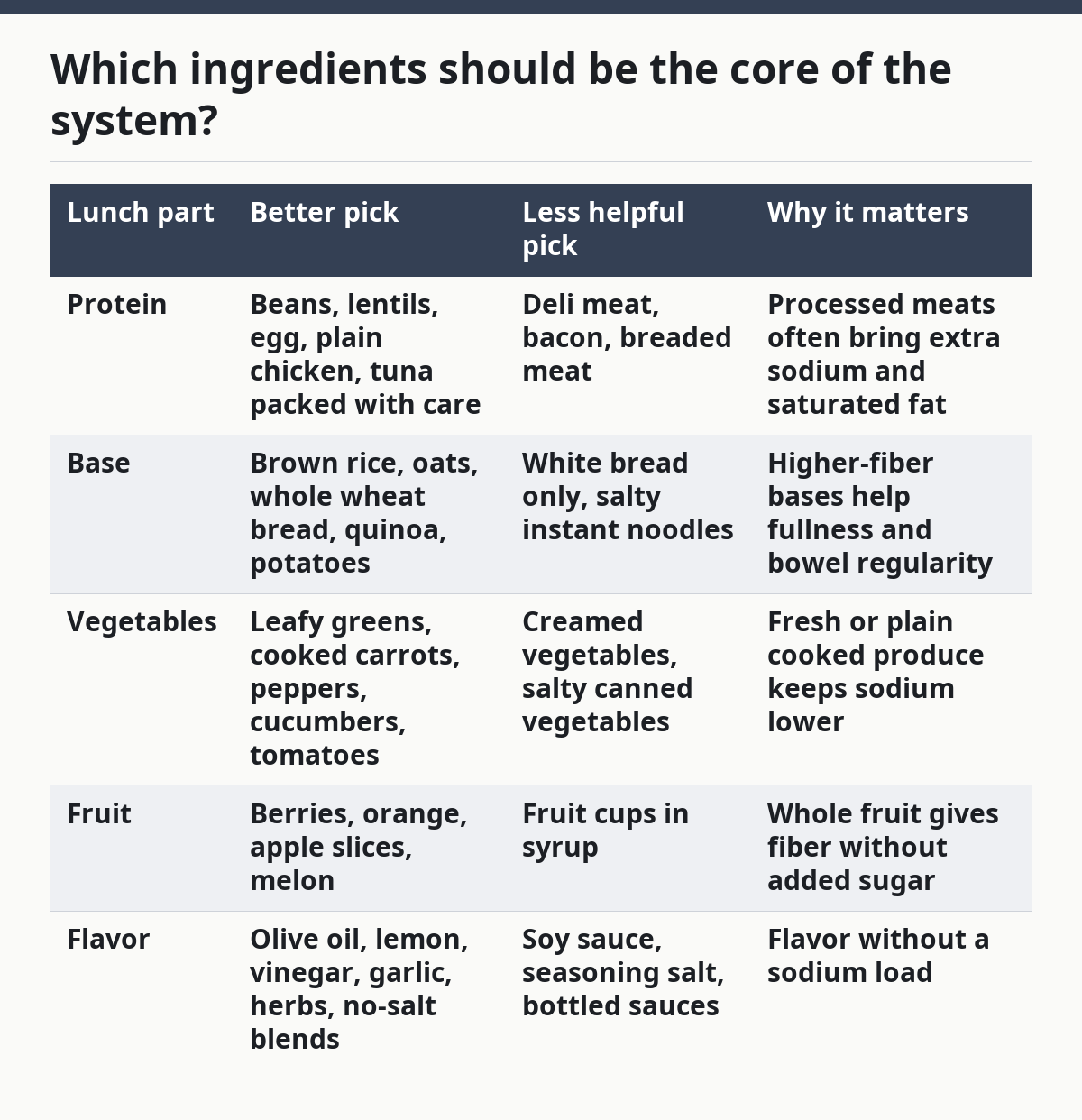
The core of the Heart-Healthy Senior Lunch Ingredient Building and Packing Systems approach should be one protein, one fiber-rich base, two produce items, and one flavor builder that does not depend on salt. That structure gives a lunch enough staying power without turning it into a sodium bomb.
A simple comparison helps:
| Lunch part | Better pick | Less helpful pick | Why it matters |
|---|---|---|---|
| Protein | Beans, lentils, egg, plain chicken, tuna packed with care | Deli meat, bacon, breaded meat | Processed meats often bring extra sodium and saturated fat |
| Base | Brown rice, oats, whole wheat bread, quinoa, potatoes | White bread only, salty instant noodles | Higher-fiber bases help fullness and bowel regularity |
| Vegetables | Leafy greens, cooked carrots, peppers, cucumbers, tomatoes | Creamed vegetables, salty canned vegetables | Fresh or plain cooked produce keeps sodium lower |
| Fruit | Berries, orange, apple slices, melon | Fruit cups in syrup | Whole fruit gives fiber without added sugar |
| Flavor | Olive oil, lemon, vinegar, garlic, herbs, no-salt blends | Soy sauce, seasoning salt, bottled sauces | Flavor without a sodium load |
The ingredient list should stay short enough to repeat. A “good enough” lunch may be hummus, whole grain bread, sliced cucumber, a piece of fruit, and a handful of unsalted nuts. Another might be leftover salmon, roasted vegetables without salt, and quinoa. The exact food can change, but the pattern should not. That repeatable pattern is what makes the system usable on a Monday morning when energy is low.
A good rule is to keep at least one ingredient ready to eat with no extra work. That might be washed fruit, cooked grains, or a pre-cut vegetable. If every piece needs chopping, cooking, and cooling the same day, the system will fail the first time the schedule gets crowded.
How do I build lunches for a week without getting bored?
Build the week by changing only one part at a time while keeping the base system the same. This cuts decision fatigue and keeps shopping manageable, which is often the real problem behind skipped meals.
A practical weekly pattern is to choose 2 proteins, 2 grains or starchy bases, 3 vegetables, and 2 fruits. That is enough variation to avoid monotony without turning the fridge into a puzzle. One week could use beans and egg as proteins, brown rice and whole grain bread as bases, carrots, spinach, and peppers as vegetables, and apples and berries as fruit. Another week could swap in salmon, plain yogurt-based chicken salad, quinoa, and potatoes.
The idea is not to create five totally different lunches. The idea is to create five lunches from the same parts in different combinations. For example, the same roasted vegetables can sit next to chicken one day, go into a grain bowl the next, and fill a whole grain wrap later in the week. The same fruit can serve as a side, a snack, or a dessert. That kind of reuse makes the system practical for a senior who cooks once and eats several times.
The other key is texture. Many older adults prefer a mix of soft and crisp, not a bowl of all-soft food or a lunch that feels dry. A soft grain, a tender protein, and a juicy fruit can make the meal easier to finish. If chewing is a problem, cooked vegetables and soft fruit are better than raw carrots or tough greens. If appetite is low, smaller portions spread across a few containers may work better than one large box. The goal is not a perfect plate; it is a plate that gets eaten.
How should the lunch be packed?
The lunch should be packed in layers that protect texture, control moisture, and keep the highest-risk foods cold until mealtime. The packing order matters because the same ingredients can taste fine or fall apart depending on how they are stored.
A simple packing system works like this:
- Put the dry or sturdy base in the bottom.
- Add the protein.
- Add cooked vegetables or crisp vegetables in a separate section.
- Pack sauces, dressings, and wet toppings in a small container.
- Add fruit in its own container or in a dry compartment.
This order helps prevent soggy bread, wilted greens, and watery grains. It also makes the lunch easier to assemble at the last step. If the meal is a wrap or sandwich, pack fillings separately and assemble right before eating when possible. If the meal is a bowl, keep crunchy items out of the liquid until serving.
Food safety matters here too. The USDA advises keeping perishable food out of the “danger zone” between 40°F and 140°F for more than 2 hours, or 1 hour if the temperature is above 90°F. That means a lunch sitting in a warm car or on a counter is not a harmless detail. Use an insulated bag or ice pack when the meal will not be eaten soon. Cold foods should stay cold, and hot foods should stay hot. For more on safe handling, see the USDA food safety guidance.
A reusable container with separate compartments often works better than one large open box. It keeps flavors distinct and gives a clear visual cue about what is in the meal. For an older adult who wants low effort, a good container is one that opens easily, seals well, and can be handled without strain.
What should the shopping list and prep system look like?
The shopping list should be short, repetitive, and built around the same 10 to 15 items each week. That keeps the system from collapsing under choice overload and makes the lunch plan more likely to happen on time.
A strong prep system usually includes:
- 1 or 2 proteins, such as beans, eggs, tuna, salmon, chicken, or plain yogurt
- 2 whole grains or starchy bases, such as brown rice, oats, whole grain bread, quinoa, or potatoes
- 3 vegetables, with at least 1 that can be eaten raw and 1 that is cooked
- 2 fruits
- 1 to 2 fats or flavor builders, such as olive oil, avocado, nuts, lemon, vinegar, or herbs
The prep day should be short and realistic. One round of cooking can cover several lunches if the ingredients are used in more than one way. A pot of grains, a tray of vegetables, one protein, and a washed fruit supply can become bowls, wraps, and simple plates across the week. If the plan depends on preparing everything fresh each day, it is too fragile for most older adults.
The main trap is buying ingredients that sound healthy but do not mix well in actual lunch boxes. A giant bag of raw vegetables is not useful if it is never cut. A low-sodium grain is not useful if no protein is ready to pair with it. A heart-healthy system works because every item has a job.
Here is a practical comparison of prep styles:
| Prep style | Time cost | Food quality across the week | Best for | Weak point |
|---|---|---|---|---|
| Daily from scratch | Highest | Fresh but inconsistent | People who cook often | Easy to skip when tired |
| Batch prep once a week | Moderate | Good if storage is organized | Most older adults and caregivers | Needs fridge space |
| Mix-and-match components | Lowest during the week | Usually steady | Low-energy days | Repetition can feel boring |
For many seniors, batch prep with mix-and-match pieces is the best balance. It reduces work without forcing the same exact meal every day.
What are the most common mistakes?
The most common mistakes are hidden sodium, too little protein, too much dry food, and packing systems that are too complicated to keep using. These are not small errors. They are the reasons a “healthy” lunch gets replaced by crackers, soup, or a sandwich with far more salt than planned.
The biggest mistake is trusting labels that look healthy at first glance. A soup, wrap, or frozen meal can still be high in sodium even when it is marketed as light or wholesome. Another mistake is using deli meat as the default protein. It is quick, but it often carries much more sodium than plain chicken, beans, eggs, or fish prepared at home. A third mistake is building a lunch that is mostly bread, rice, or pasta with very little protein or produce. That kind of meal can leave a person hungry again soon after eating.
There is also a texture mistake. Some lunches are packed in a way that makes them unpleasant by noon. Wet fillings turn bread soggy. Hot vegetables release steam into a closed box. Dressing poured over greens too early turns salad limp. A good lunch system separates ingredients until the last possible moment.
The final mistake is aiming for perfection instead of repeatability. A senior lunch plan does not need exotic ingredients, elaborate recipes, or a dozen steps. It needs enough structure to keep the meals heart-friendly for several days in a row. If the system cannot be repeated with low energy, it is the wrong system.
A simple rule helps: if an ingredient adds sodium, needs special handling, or makes the box messier, it must earn its place. If it does not, cut it.
Which lunch systems work best for different needs?
The lunch system depends on chewing, appetite, schedule, and how much cooking energy is available. A single approach will not fit every older adult, and that is where many generic meal plans fail.
| Need | Better system | Why it fits | Possible drawback |
|---|---|---|---|
| Low appetite | Smaller portions in 2 containers | Less overwhelming | May need a planned snack later |
| Chewing trouble | Soft grains, cooked vegetables, tender protein | Easier to eat | Can feel repetitive |
| Low cooking energy | Batch prep once, eat 3 to 5 times | Less daily work | Needs storage space |
| Blood pressure focus | Very low-sodium ingredient list | Easier sodium control | Requires label reading |
| Easy travel | Separate components in a leak-proof box | Portable and simple | Needs good container quality |
A senior who eats slowly may do better with a lunch split into two smaller boxes instead of one large meal. That can reduce pressure to “finish the whole thing” and may help appetite. Someone who needs a softer diet may do better with cooked vegetables, fish, mashed beans, yogurt sauces, and fruit that is soft enough to bite without strain. Someone who is often out of the house may need foods that hold up for 4 to 6 hours in an insulated container, with no delicate greens or watery sauces.
A plain, repeatable system beats a flashy one. That is especially true when the goal is heart health over the long term. The system should fit the person, not force the person to fit the system.
What tools make the system easier?
The most helpful tools are the ones that reduce friction in the kitchen and at the table. A container with separate compartments, a small sauce cup, a cutting board that stays steady, and an insulated lunch bag can matter more than any recipe.
A useful setup often includes:
- Leak-proof containers for grain bowls or salads
- Small cups for dressings or sauces
- An insulated bag for lunches that will sit out
- Reusable ice packs for cold foods
- Labels or masking tape for date marking
- A simple check list for shopping and prep
The value of these tools is not fancy design. It is consistency. If the lunch box always has the same place for protein, vegetables, fruit, and dressing, packing becomes automatic. That matters for seniors who want to save energy for the rest of the day.
The simplest tool is often a short written list taped inside a cupboard or on the fridge. It can say: protein, grain, vegetable, fruit, sauce, ice pack. That one list reduces missed items and prevents the lunch from becoming just bread plus snacks. It also helps a caregiver or family member pack the meal in the same way every time.
A heart-healthy lunch system does not need a special appliance. It needs a repeatable route from fridge to container. The less thinking required, the more likely the meal is to be packed, carried, and eaten.
How do I keep the system safe and realistic?
Keep the system safe by storing food cold enough, using the same packing order, and choosing ingredients that can survive a few days without stress. Keep it realistic by limiting the plan to foods that can be bought, chopped, cooked, and eaten on a normal week.
Food safety comes first. Perishable lunch items need prompt refrigeration and an insulated bag when they travel. If the food is meant to be eaten later, it should not be left to sit at room temperature for long. That is especially important with dairy, eggs, fish, poultry, cooked grains, and cut produce.
Realism matters just as much. A lunch system fails when it expects a perfect mood, a perfect schedule, or a perfect appetite. Older adults often deal with lower energy, medication changes, dental work, or simple boredom with food. The system should expect those realities. That means keeping backup ingredients on hand, such as no-salt-added canned beans, plain oats, whole grain bread, fruit, and frozen vegetables without sauce.
It also means deciding what this guide is not for. If someone has kidney disease, severe swallowing trouble, food allergies, or a medical sodium restriction that is tighter than general heart-health advice, the lunch plan should be checked with a clinician or registered dietitian. A generic system is useful, but it is not a substitute for medical advice when the stakes are high.
The best test is simple: can the lunch be built in 10 minutes or less once the base prep is done? If not, it is too hard for regular use.
FAQ
What is the easiest heart-healthy senior lunch to pack?
The easiest heart-healthy senior lunch to pack is a grain bowl with a low-sodium protein, cooked vegetables, and fruit on the side. It works because the parts can be made ahead and stored separately, which cuts down on sogginess and last-minute work.
How can I lower sodium without making lunch taste bland?
Lower sodium without making lunch taste bland by using lemon, vinegar, garlic, onion, pepper, herbs, and small amounts of olive oil instead of salt-heavy sauces. The flavor has to come from acid, aroma, and texture, not from a shaker.
Is soup a good lunch for older adults?
Soup can be a good lunch for older adults if it is low in sodium and paired with protein and produce. Many canned or restaurant soups are salty enough to use up too much of a day’s sodium budget too fast, so labels matter.
What if chewing is hard?
If chewing is hard, choose soft foods such as cooked vegetables, beans, eggs, yogurt-based spreads, flaky fish, soft fruit, and tender grains. Crunchy raw vegetables and tough meats may need to be cut smaller, cooked longer, or replaced.
How long can a packed lunch sit out?
A packed lunch should not sit in the danger zone between 40°F and 140°F for more than 2 hours, or 1 hour if the temperature is above 90°F, according to USDA food safety guidance. An insulated bag with an ice pack helps keep cold foods safer until mealtime.
For more heart-health guidance, see the American Heart Association’s sodium advice and the USDA MyPlate pattern:
https://www.heart.org/en/healthy-living/healthy-eating/eat-smart/sodium
https://www.myplate.gov/
A senior lunch system works when it is dull in the best way: the same steps, the same container logic, the same short list of ingredients, and fewer decisions each day. That is how Heart-Healthy Senior Lunch Ingredient Building and Packing Systems become a habit instead of a project.
Drafted with AI; not yet reviewed by a person.


